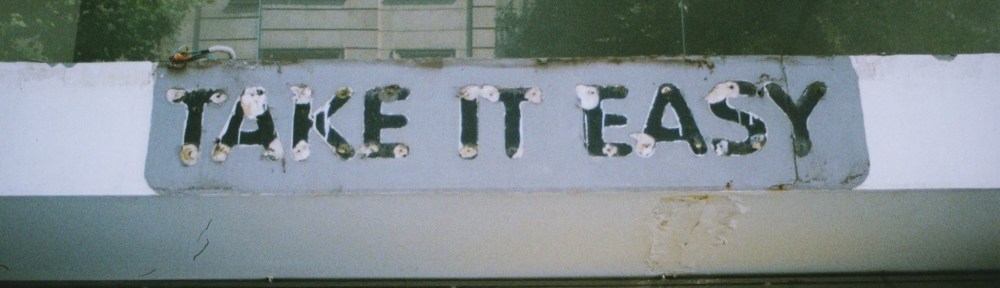
Before beginning this article, I was officially ordained as a Dudeist priest, which imparted the authority to minister over Dudeist religious ceremonies, preside over weddings, funerals, or simply kick back and celebrate being amongst 220,000 others ordained within the ‘most easygoing religion in the world’. The ordination was a fairly simple process: provide some basic information, swear loyalty to the ‘Take It Easy Manifesto’ ™, declare the slacker philosophy as a personal credo, and within minutes receive welcome into the Church of Latter Day Dude, complete with a certificate I can print and laminate for my wall.
The simple fact that The Big Lebowski (1998) has accrued a mass following, to the point of its conversion into a religious doctrine and philosophical way of life, speaks volumes of the degree to which the Coen Brother’s cult classic flipped traditional narrative and social constructs on its axis. The film prevails with the chaotic grace of an ice-skating crocodile, giving birth to a new form of story which represents the “normal man” as the hero in a form of inverted hierarchy, where success and wealth is not celebrated so much as The Dude’s individual pursuit to keep his own life within the realm of inconsequentiality.
The “Dude” Lebowski is the alleged ‘man for his time’; the full embodiment of the nihilistic, stagnant decade of people brushed under the economic rug with the institution of Reaganomics and its direct beneficial aim towards white upper class society. While he is now considered amongst the bums, his character passively states he was once a member of an activist group in the sixties, known as The Seattle Seven. The Seattle Seven was a left leaning anti-war organization famously tried and convicted with “conspiracy to incite a riot” in the wake of violent protests at a court house, with each member receiving a six-month jail sentence from a grand jury willing to go to any length to combat the radicals. Amongst the actual members of the S.7 was Jeff Dowd, who now lives in Los Angeles, California, is a good friend to the screenwriters of TBL, Ethan and Joel Coen, and is ultimately the inspiration for The Dude’s character. By naming himself as a past member of one of the most radical activist groups in the US during the Vietnam Era, the audience gains a more complete perspective of The Dude as someone who has been discouraged from the political realm upon realization of its corruption.
The film’s era was characterized by a sense of instant gratification and the chase for easy success without sacrifice, which was largely due to the growing stock market and many reported instances of overnight wealth acquired from surging enterprise. There was a dynamic shift from Americans wanting to work for their money to the desire for it to just manifest in front of them with minimal effort, which gave birth to what has been historically referred to as ‘the slacker movement’. The American Dream and the pursuit of happiness was growing stale because many were too drained, nihilistic, or in the Dude’s case, lazy, to partake in the pursuit aspect of it. Complacency had replaced happiness for many, and the Dude’s character was an allegory of this universal stagnancy, while still being antithetical to traditional protagonists in his lack of quest for love, justice, or meaning.
His character is a unique instance where there is no sense of transformation or character arc, remaining steadfast in his personhood from the beginning to end, making no decisions to abandon his deadbeat lifestyle and pursue success. Even when he believes he is going to receive 20,000 dollars from Mr. Lebowski, his greatest concern is whether it will bump him up into a higher tax bracket – a subtle reference to Reaganomics methods of taxation. Then, when he does not end up receiving the 20k, his response is “Fuck it, let’s bowl”, indicating the money would have made no real impact in his life. He is complacently satisfied in his own realm, which lends social criticism to the ideology that all aspects of life must be tinged with upward mobility. It offers an alternative appreciation for people not continuously trying to better their position in life or achieve more for themselves.
The structure of the film places importance on what is traditionally considered mundane, giving particular attention to oft overlooked details. In example, the opening sequence of the film is a montage comprised of shots of bowling balls, pins, overweight people bowling in slow motion, and a long-take of a bored man spraying shoes with disinfectant. These shots are not aesthetically pleasing or conventionally beautiful, and the sequence is not an attempt to paint them as such. It is instead a look into TBL’s meticulous universe, where the commonplace is given significant value. The details counterpose the actual characters insofar as they promote awareness of the Coen Brother’s sense of purpose when writing the script. Every little element contains a purpose, and most prevalently, the purpose is to parody American civilization.
Every ‘fuck’ (used 269 times) ‘man’ (used 174 times) ‘dude’ (used 144 times) and ‘shit’ (used 98 times) is entirely scripted, with not one instance of improvisation. This arguably crude set of language was not intended to solve dialogue deficiency, or because the Coen brothers couldn’t write intelligently, it was inserted with intent of “liberating language from the norms of good sense” (Martin, 4). If the Dude doesn’t want to expand his lexicon then it’s his personal prerogative, no social pressures are going to dictate he cease his expletives, and in a way he releases pure language from this sense of higher morality. Despite his general lack of motivation, he still possesses an inherent goodness, for instance, when he stands up for the likes of “fragile” Smokey when bullied by Walter, is concerned for Bunny’s life, and truly doesn’t appear to have a vindictive bone in his body. His morals appear in good faith, the only thing subject to criticism is his ‘bad’ language. This is brought to the forefront of the film’s attention in the scene where The Dude encounters The Stranger in the bar. The Stranger first praises the dude, saying he “likes his style”, but then continues to say, “but there’s just one thing, do you have to use so many cuss words?” to which The Dude responds, “The fuck you talking about?”, which indicates he doesn’t even consider ‘fuck’ a bad thing to say. The Stranger, portrayed by Sam Elliot, known for his roles as the American Cowboy, represents not only an earlier generation, but also an earlier period in cinematic history, the period of wholesome cowboys with inclinations towards justice. When seen in juxtaposition with The Dude, just a regular guy in a sweater and jelly shoes with no aims to prevail over evil, the scene gives the impression of regarding the old classification of ‘hero’ as irrelevant and unrealistic in the parlance of the times.
On the opposite end of the moral spectrum, there is Mr. Lebowski, who is manipulative, fraudulent, hypocritical, and doesn’t utilize one solitary curse word. In making this distinction between the two Lebowskis in regards to morality and language, it becomes apparent they are mutually exclusive terms and society should treat them as such. It leads the audience in a line of questioning on the origin of the semiotics involved within the word “Fuck”, and what lead to its negative connotation and banishment from everyday vernacular to begin with. The Coen brothers are well known for their subversive semiotics, and the greatest case of this is in their Academy Award winning film, Fargo, which had been released one year before TBL, and is further proof of the purpose laden origin of the diction within the film.
A critical aspect of the film is the political atmosphere in which it is set. The film takes place in the early 90’s, which was in the crux of the Gulf War. The opening scene of the film contains a shot of a television showing George Bush senior’s speech after the attack on Kuwait, stating, “this aggression will not stand”. The Dude appears to have no interest in the war, the invasion, or the president himself, but in a later scene he uses the identical phrase “this aggression will not stand” when referring to someone who urinated on his favorite rug. This draws a parallel across what is happening in the Dude’s personal universe and what is happening in the real world, bringing to head the question of relativity when dealing with ‘acts of aggression’. On the political front, the Iraqis came out of nowhere and annexed Kuwait, resulting in the shutdown of oil refineries and subsequent economic reverberations, and in the Dude’s world, the Chinaman came out of nowhere and urinated on his rug, serving as a catalyst for an entirely different sequence of events had the urination not occurred. Furthering the parallel to the Gulf War, when The Dude is telling the story to his best friend Walter Sobchak, Walter begins comparing the situation to his own time in Vietnam, stating it is time the Dude “draws a line in the sand which one does not cross”. Walter symbolizes the views of neoconservatists with his entrenched militarism and flagrant righteousness, a new stereotype associated with members of the Bush Administration. He is so steadfast in his liberty, he even invokes his first amendment rights and references his friends who died face down in Vietnam just so he can justify swearing loudly in a family restaurant. Walter’s attitude drives the plot and hypes the rug-urination situation up, with his angry repetition of the phrase “the rug is not the issue here!”, he turns the minor incident into a symbol of aggression against American liberties, and in this case it is The Dude’s right as an American to possess a rug that “ties the room together”. This parallels the Gulf War in the initial passivity of many people towards something occurring so far away from home soil, but in the repetition of news phrases, calls against aggression, and reminders of our destiny to serve and protect, the media and government were able to get people riled up against the Iraqis and in support of an ambiguous war by claiming it was an attack against the American way of life.
Another precarious element in the film is the social parameters defining its existence, and in order to establish these parameters, the characters are written not with realistic levels of humanness, rather as extreme caricatures. The common denominator with every character is that they observe no change through the course of the film, which does not indicate perfection, rather that they are representative of the ‘unrepresentable’, and to change any facets of themselves would be to lose the narrative voice which only exists within the precincts of this Lebowski universe. Another indictment of their caricature nature is each character finding themselves in unnatural seeming dialogue loops, where they repeat the same phrase in excess amounts, jarring viewers out of their willing suspension of disbelief and bringing awareness to the writing in the film itself. Bringing awareness to the writing is a risky mission for screenwriters to pursue, but in TBL’s case provides a unique sense of direct character-audience dialogue wherein the audience feels the character invading their own personal thought hemisphere with their words.
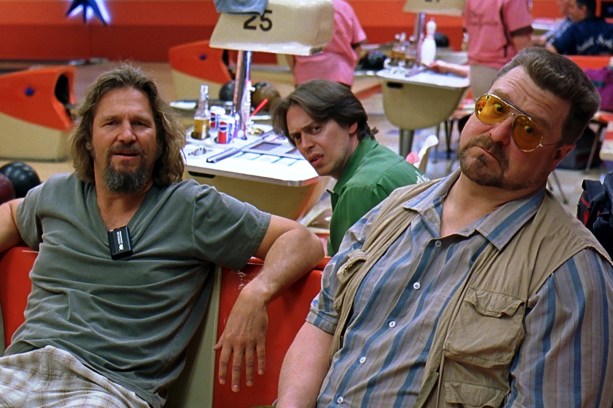
Jeff Bridges as “The Dude” hangs out at the bowling alley with his buddies Walter (John Goodman) and Donny (Steve Buscemi). Courtesy Universal Studios.
In a 2007 article published in Communication Studies by Paul Martin and Valerie Renegar, a stance is taken on the film arguing that it employs carnivalesque rhetoric structure as a way of giving audiences the opportunity to “see the world through a different system of evaluation” (Martin. 4). Carnivalesque rhetoric and its associated sphere had been earlier defined by Mikhail Bakhtin in 1963 as “the place for working out, in a concretely sensuous, half-real and half-play-acted form, a new mode of interrelating between individuals, counter-posed to the all-powerful socio-hierarchical relationships of non-carnival life” (Bakhtin, 1963. Pg. 124). Martin goes on to say carnival exists as a vehicle of social critique, and applies this to TBL. Bakhtin outlines three qualifying factors which must be present within something to allow its classification as carnivalesque. The first qualifier is “Grotesque Realism”, which with TBL’s preponderance of perverted language, references to male/female genitalia, and highlighting of beer bellies bowling or faces being shoved in toilets, certainly grants qualification for this description. Martin argues the purpose of this grotesque realism fueled towards the carnivalesque in the film is to “inspire an interrogation into the conservative and hierarchical constraints society imposes on them and between them” (Martin. 8). The purpose of the grotesque is to eliminate the shame or embarrassment one is supposed to feel in response to impropriety, and to fuel criticism on why they’ve been designated as improper to begin with. The second aspect of the carnivalesque is the “Inversion of Hierarchies”, which entails the “dethroning of rulers while the lowly take their place” (Bakhtin, pp.122-123). The entire plot of the film is driven by this concept, as the lowly Dude is praised for his Dudeness and those in a position of power and influence are made a fool of and even more in concurrence with the carnival aesthetic, proven to be not in a position of power at all, in example when it is discovered Mr. Lebowski has been embezzling money from his own charity – another allusion to corrupt politics.
The third element of Carnivalesque rhetoric is “structural and grammatical experimentation”, and while TBL was initially criticized for the structure being akin to a “convoluted fun house ride” (Glieberman 1998, 1), it is the lack of traditional structure and intentional confusion that parodies predictable movie plot twists. What is supposed to be a story about a kidnapping wraps up with the alleged kidnapee going on an impromptu trip to Palm Springs. What was supposed to be a threatening gang stealing the Dude’s car with the briefcase, ended up being an eleven-year-old kid failing social studies. When we believe the Nihilists are going to hurt Donny, he actually dies from a spontaneous heart attack. All of these incongruities combat any semblance of predictability and create their own disrupting cinematic style, “revolutionizing how people see their worlds” (Bakhtin. P,16).
Analysis of this film has breached grounds the writers themselves never thought possible. Entire books have been written both critiquing it and preaching the associated Dudeist philosophy. It has even lead to the creation of “Lebowskifests”, which entail massive celebrations where there is a screening, bowling competition, and costume contests. The most impressive part about the film as a whole is that while some may appreciate it for its social and structural criticism riddled with political allegories and stereotypes, there are still massive quantities of people who just think it’s simply a funny movie and a good excuse to knock back a few White Russians ™ with their buddies.
Works Cited
Averintsev, S. “Bakhtin and the Russian Attitude Toward Laughter” Critical Essays on Mikhail Bakhtin .pp.278-282. Trans. T. Cunningham. New York: G. K. Hall & Co.
Bakhtin, M. M. “Problems of Dostoevsky’s Poetics”. Trans. C. Emerson. Minneapolis, MN: University of Minnesota Press. 1963.
Haglund, David. “Walter Sobchak, Neocon” The Slate. 11 Sep 2008. Acc. Dec 3, 2014.
Jacobs, Tom. “Scholars And The Big Lebowski: Reconstructing The Dude” The Science of Society. New Hampshire: July 2011. Online. Acc. Dec 3, 2014.
Martin, Paul & Renegar, Valerie. “The Man For His Time” Communication Studies. West Lafayette: Sep 2007. Vol. 58, Iss. 3, p. 299. Print
Norris, Christopher. “Uncritical Theory: Postmodernism, Intellectuals, and the Gulf War”. Pp, 127-45 Lawrence & Wishart. NY: 1992 Feb. Print
 THE CONTRA POST