
In a personal study conducted by myself at a party, I went around asking inebriated individuals if at that exact moment they would rather have awesome animal sex or a massive Chipotle burrito – complete with the egregiously priced $1.95 guacamole. Not surprisingly, most of the men I posed this question to answered with sex, while the majority of females opted for the burrito. My findings compelled me to do more research into the universality of this, and I located a detailed study on the matter in the Rochester University Medical Journal – now here’s the kicker, it’s not some banal “psychological” experiment. Their hypothesis went way deeper than pulling 50 individuals out of a college campus and asking them questions or depriving them of sex and burritos, but instead focused on whether biological sex has a direct linkage with behavioral prioritization, and if so, what direction is each gender likely to go, and why?
These intrepid RU badasses used free-living transparent Nematodes, also known as Caenorhabditis elegans, to get to the bottom of this very important issue. Nematodes are pretty metal. What these lil’ guys lack in terms of a respiratory and circulatory system (they don’t have either), they make up for in possessing advanced nervous and neurological systems, hence why they are often chosen for studies of the why the fuck does this happen nature.

A majority of these species are female hermaphrodites, but there does exist small percentage of “true” males. For my own sanity during the remainder of this article I’m just going to refer to the female hermaphrodites as hermies – also because I have that song playing in my head about Hermie the worm chewing his bubblegum chomp, chomp, chomp, after he ate his own mother. Don’t have any idea what I’m talking about? Well its about to get worse than obscure summer camp chants. I’m about to science the crap out of you – so hang on to your hats.
C. elegans are already considered to display sex-specific behaviors, exhibiting differing levels of acting out shared mannerisms, possessing varying senses of smell, different associative learning capabilities, tendencies towards exploration, and subtle differences in locomotion. The experiment itself involved placing a hermie and a male in separate environments, each with a solitary food patch. Hermie appeared satisfied to stay with the food and consume it, while the male would leave the food to explore his environment. The scientific origination of this behavior is a result of sexual differences in olfactory (smelling) stimulus and the internal regulation of the Diactyl receptor OTR-10 (Diactyl: an organic compound with intense buttery flavor, added to some foods – next time you head to The Cheesecake Factory, ask them to go heavy on the Diactyl. It’ll be a real hoot n’ holler.).
The data displays that the male contains a downgrade of OTR-10 as opposed to females, meaning he has less of a neurological inclination to search for food as his sense of smell, which is directly related to pleasure center, is less prominent. This explains his desire to explore instead of focus on the food, unless in a case of starvation, where he experiences an upsurge in OTR-10. The follow up question to this was whether both genders use the same circuitry to detect diactyl or if they have sexually unique methods of detection.
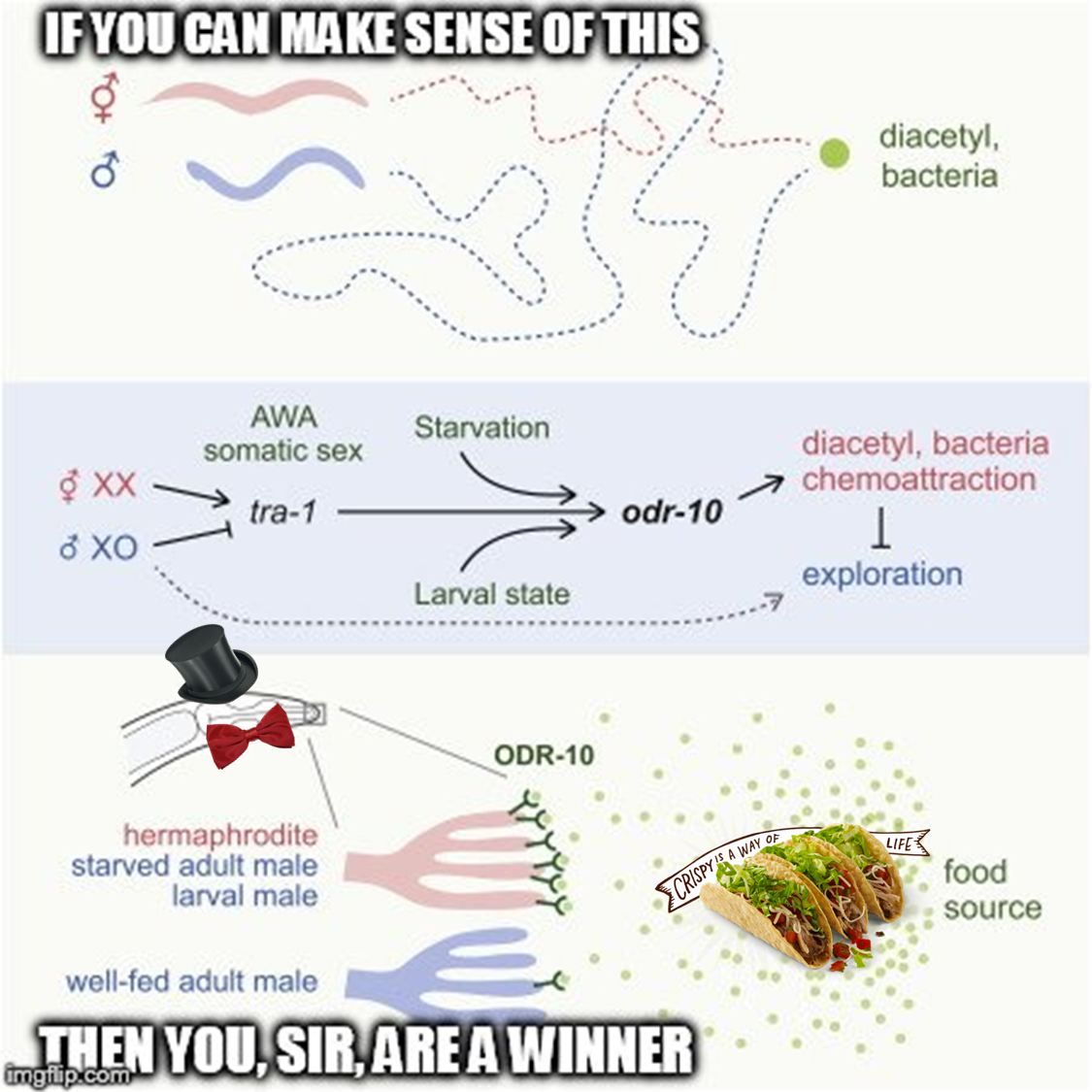
hermie gets a bow tie
In response to this inquiry, hermaphrodites were shown to primarily use an AWA olfactory neuron pair (sensory neurons), while the secondary contribution came from AWC neurons. In males, however, their attraction to diactyl only utilizes the AWC, completely neglecting the use of AWA. This proves that genetic sex reconfigures the diacetyl circuit. Where females rely on two sensory neuron pairs to sense diactyl, males rely on only one. To make it more plain and simple to the layman: Hermie gets double the pleasure and double the fun from food than our Male, because she has two sets of neurons running, whereas our male doesn’t activate his second set. He has no idea how goddamn good a Burrito can even be.
Now, to reach the conclusion that males not only have less of an attraction to food, but a greater neurological inclination towards sex, required another series of experiments. The follow up was a test of reproductive fitness, where a male was required to navigate through a patchy food environment in order to mate – talk about working for the booty. This sex-Olympics was done to many males, and after several hours all of the males had migrated to the center mating spot.
When Hermie was placed in the food-obstacle course and expected to navigate towards the mating spot, nearly every single one found a nice food patch and decided to chill there for the rest of the experiment. None of them were down for some Nematode-whoopee. Perhaps if the euphony of Marvin Gaye’s Lets Get It On had been scaling the walls, this experiment would have yielded different results.

baby makin’ music
These series of experiments lead the scientists to draw the conclusion that the repression of ODR-10 is explicitly tied to adaptive reproductive fitness, leading males to “prioritize sexually motivated exploration over feeding”. Once again, to the layman: Because Males don’t activate their second set of neural transmitters (AWA) and they don’t smell how delicious a burrito can possibly be, they are more down for sexplorations, whereas hermies (or women) are pretty damn satisfied to chomp chomp chomp.
These conclusions seem to reinforce my view on the entire Burrito vs. Sex quandary, but I also can’t seem to reconcile this reproductive fitness adaptation as the primary reason that men prioritize sex, and I also don’t want to get too hasty in the assumption that these criterion apply for all males or all women. Worms are manifestly not as complex as humans, and merely provide a simple hypothesis for a very complex question.
So I guess this article is for the dudes who love burritos and the women who love sex.
Divergent motherfuckers with their middle fingers raised to biological prioritization.
That’s pretty damn metal.

Relevant.
If you would like to check out the study:
http://www.cell.com/current-biology/abstract/S0960-9822(14)01153-1
 THE CONTRA POST